

What makes a native planting design actually work?
We've spent the last two posts talking about what "native" means and why ecotype matters. Those are important topics, but they don't cover everything that goes into designing a new planting. After all, you can plant every native species in the book and still end up with something that looks like a weed patch. So let's talk about design.
I get asked some version of this a lot. What actually separates a native planting that looks intentional from one that looks like, well, a mess? There's a lot that goes into it, honestly more than fits in one post, but here are a handful of the things I think about on the ground when I'm laying out a bed.
There's layers to it
If you walk along the edge of any healthy patch of woods, you'll notice there are several layers stacked on top of each other. Trees up top, a dense shrubby layer catching the extra light at the edge, then perennials and groundcover filling in low to the ground. In nature, every layer is doing its own job at its own height.
A good planting bed borrows that logic even if the planting doesn't include trees. It also points you toward a pattern worth borrowing from nature directly: species that share the same patch of ground without actually competing for it, because each one is using a different part of that space. This is called resource partitioning. As an example, a taller plant can give a shorter, shade tolerant species the break from full sun it's looking for.
Layering also gives plants something to physically lean on. As an example, Culver's Root is a tall spike of white flowers that leans once it hits full height, but planted among switchgrass, the stiff grass stems give it something to lean into. Coneflower has the same habit. It flops when it's crowded by other soft stemmed plants, and stands up fine when it's got sturdy grasses nearby to lean into during wind and rain. Look at how plant communities already sort themselves out in the wild and a lot of your pairing decisions get made for you.
Group your plants
Piet Oudolf's drifts are the piece I lean on most, planting one species in a loose cluster, five or seven or eleven plants, repeated across the bed. Odd numbers specifically. A group of five or seven has a rhythm to it. From across the yard, a drift shows up as one continuous sweep of color and texture.
I see the opposite mistake constantly, and honestly I made it myself early on. You fall in love with one plant at the nursery and tuck it into the bed by itself because you like it. On its own, surrounded by other stuff, it just looks lonely. A single Coneflower or a lone clump of Little Bluestem looks like an afterthought no matter how nice the plant is, and a bed full of those one-off choices ends up feeling scattered, disjointed, and chaotic. But if you group four or five of the same plant together, it looks more composed and natural.
Roots
Roots are easy to neglect thinking about because they’re underground. But what’s interesting is that different species draw water and nutrients from different depths. Something like Love Grass feeds from the top few inches of soil, while a Coneflower or Goldenrod sends roots down much deeper. If you stack species with different root depths in the same bed, they end up drawing from mostly separate zones. Plants will still compete some of course, that never fully goes away, but this is a real reason a well designed bed can pack in more life per square foot than you'd expect.
Contrast textures
Color gets a lot of attention in a garden, but texture is what actually keeps a bed interesting, especially once the blooms are gone. I try to mix shapes on purpose, something flat and daisy like against something round and clustered, with a softer grass texture worked in underneath. If you skip that and use plants that are all built the same way, even a great color palette starts to fall flat.
Plan the whole season
When I approach a planting, my goal is a bloom schedule that spans the whole season, spring to frost. A typical bed might open with golden Alexanders, move through blue violet with beardtongue and wild indigo, soften into white and lavender pink through summer, and close gold and bronze with goldenrod and bluestem in the fall. Pretty simple: there is a beginning, middle, and an end.
That timing is deliberate for a reason beyond looks. Different pollinators are active at different points in the season, and a gap in bloom is a gap in food for whatever's flying at that moment. Planning the sequence carefully means there's always something feeding something, from the first mining bees in spring to the last migrating monarchs working goldenrod before frost.
Leave the skeleton standing through winter
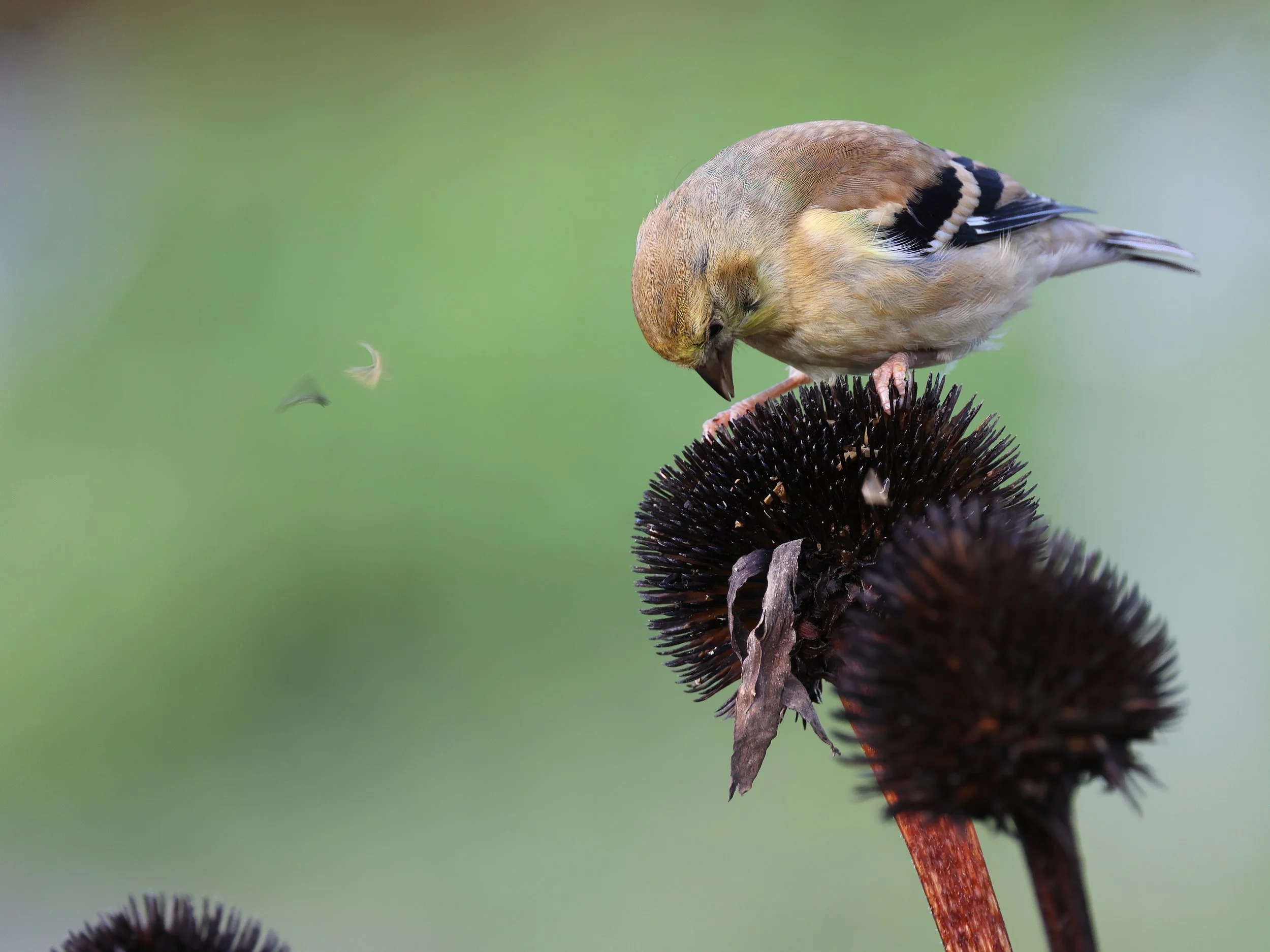
Cephas, CC BY-SA 4.0, via Wikimedia Commons
Most conventional landscaping gets cut back hard every fall. Given the importance these habitats have for pollinators and wildlife, we don't on purpose. Coneflower and goldenrod seed heads feed goldfinches and chickadees through the winter, when food is genuinely scarce. Dried stems double as nesting material for native bees the following spring. A bed full of seed heads and switchgrass or little bluestem plumes under a dusting of snow just looks good, too.
That's the default. Some clients want a tidier look going into winter, especially a business with a public entrance, and I'll work with that. But left alone is always my first recommendation.
Design for the whole timeline
Native perennials spend year one building roots, not top growth, so a bed planted at its proper mature spacing looks thin the first season almost no matter what. I plan for that upfront: a mix of faster establishing species that carry visual weight early, alongside slower, longer lived plants like Baptisia that are working underground before they show much above it. Spacing gets set for what the bed will look like at year three, not for what looks full on install day. It’s challenging to be patient, but watching it catch up to that plan over a couple of seasons is one of my favorite parts of the job.
None of this makes a planting more native. Layering, grouping, root depth, texture, bloom sequence, all of it comes down to understanding how plants actually behave together and building around that instead of guessing. Design is what turns a list of the right species into something that feeds pollinators from spring through frost, holds itself upright in a windstorm, and still gives you something to look at in January. Get the plant list right and get the design right, and you end up with a garden that's doing real ecological work while looking like someone meant it to be there.
