

01 | What We Actually Mean When We Say "Native"
Since Wild Heart Nativescapes is built entirely around native plants, this feels like the right place to start. At its most basic, a native plant is one that grew in a given region on its own, without people bringing it there, and evolved alongside the insects, birds, and soil in that specific place over a very long time.
That's the simple version. But from there, the definition can get complicated quickly. The first question is timing: how far back do you go to decide a plant got here "on its own," rather than with help from people? Some definitions use European settlement as that cutoff, meaning a plant counts as native to Maine if it was already growing here before European settlers arrived. That sounds precise, but it treats that one moment in history as the finish line, when really the ecosystem has kept changing since.
There's also a second question, separate from timing: how local does "region" need to be for the word "native" to actually guarantee what we care about, the relationship between a plant and local wildlife? A plant can carry the "native" label and still be a stranger to the insects in your specific area.
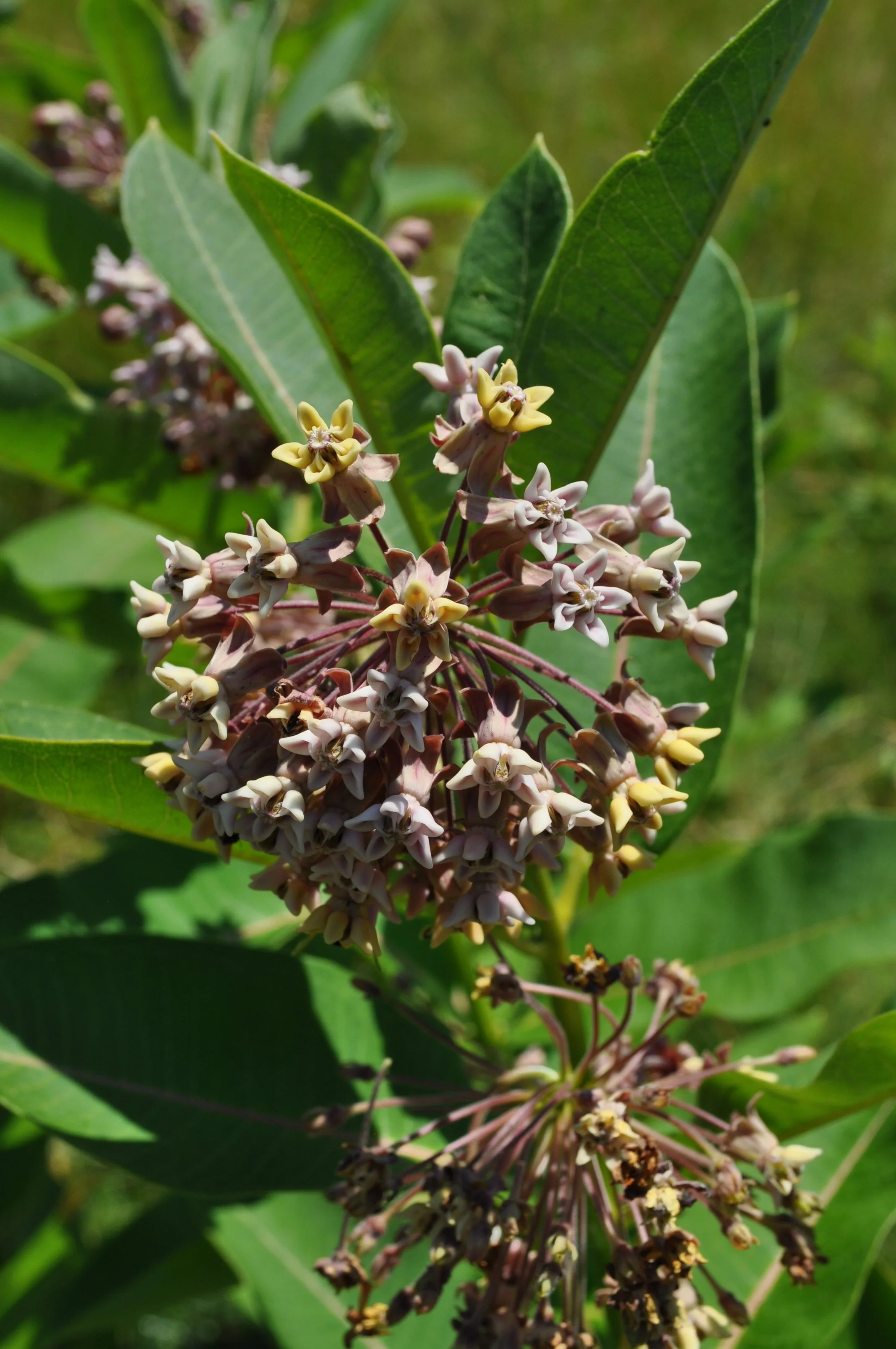
Common Milkweed, by NY State IPM Program at Cornell University from New York, USA - Asclepias syriaca - inflorescence, CC BY 2.0, https://commons.wikimedia.org/w/index.php?curid=110359263
Take common milkweed (Asclepias syriaca), the host plant monarch caterpillars depend on. It's native across most of the eastern half of the country, so a nursery in Maine and a nursery in Texas can both sell it as a native plant, and both would be telling the truth. But milkweed grown from Texas seed adapted to Texas conditions over generations. It may flower earlier in the season than milkweed grown from Maine seed, because it evolved to match a different climate and day length. Plant that Texas-sourced milkweed in Maine and the species checks out as native, but the timing might not line up with when Maine's local monarchs actually need it.
That's the real issue with locality. A species can be broadly native and still lose the local fine tuning, bloom time, chemistry, timing, that built up between a specific plant population and the specific insects living alongside it. Plant people have a word for this: ecotype, a locally adapted version of a species shaped by generations in one specific place. We'll get into ecotypes in more depth in a future post, but the short version is that the label "native" tells you the species belongs somewhere in that range. It doesn't tell you whether this particular plant, grown from this particular seed source, still matches the insects in your yard.
A few real definitions show how differently people answer the two questions we just raised. The California Native Plant Society answers the timing question with a hard cutoff: native means present before European contact. The federal government takes a looser stance. In Executive Order 13112, the order that set federal invasive species policy, a native species is defined as one that occurred here historically or occurs here now, as long as people didn't bring it in. No cutoff date required, just no human hand in getting it here.
Then there's the locality question, which Doug Tallamy has done more than almost anyone to push into the mainstream. He's an entomologist at the University of Delaware and the author of Bringing Nature Home, the book credited with kicking off a lot of today's native plant movement. His answer to "how local" is to throw out state lines entirely and think in ecoregions instead, since plants follow soil and climate, not political borders.
Here's ours. The history still matters, a plant's deep, evolved relationship with local wildlife is exactly why native plants work as well as they do, and it's the foundation everything else builds on. But we don't stop there. A plant is native, in our book, if it evolved alongside wildlife here, is still supporting that wildlife today, and is a good bet for supporting it going forward, including the pollinators arriving in Maine right now because their range is shifting north with the climate. That last part grows directly out of the historical picture. Those pollinators are following the same evolutionary instincts that built every native relationship in the first place, just on a faster timeline than usual, and the plants that can feed them deserve a place in that definition too.
That migration piece is already happening. A recent global study of over 1,700 butterfly species found 80% have expanded their ranges, mostly due to climate change, with insects moving north faster than their host plants can follow. Planting the right natives now, ahead of that gap, means the wildlife arriving in Maine will have something to eat when it gets here.
So when we say native, that's what we mean. It's the definition that guides our work, and the one we think does the most good.
