
Plants with deep roots here.

This native plant bed was designed specifically for Woof Play Eat: full sun, parking lot heat, and curious pups at the edges who sometimes have to go! Every species was selected with your dogs in mind. Tap any plant below to learn more about what makes it fun and unique!

Krzysztof Ziarnek, Kenraiz · CC BY-SA 4.0 · Wikimedia Commons
The foundational layer of the entire bed. Fine, arching blades form a dense mat between the taller plants, suppressing weeds and giving the planting a cohesive living floor. Planted throughout at 105 plugs, it handles paw traffic at the edges better than almost anything else, and it holds its composure through the baked, dry heat of the parking lot all summer.

BeckyLaboy · CC BY 4.0 · Wikimedia Commons
The structural backbone of the planting. Blue-green all summer, then a full conversion to coppery orange-red in fall that holds well into winter. One of the toughest grasses in the Northeast, perfectly suited to the baked dry conditions along this parking lot edge. Fifty plants in clusters of five to seven give the bed its signature mass and seasonal color shift.
D. Gordon E. Robertson · CC BY-SA 3.0 · Wikimedia Commons
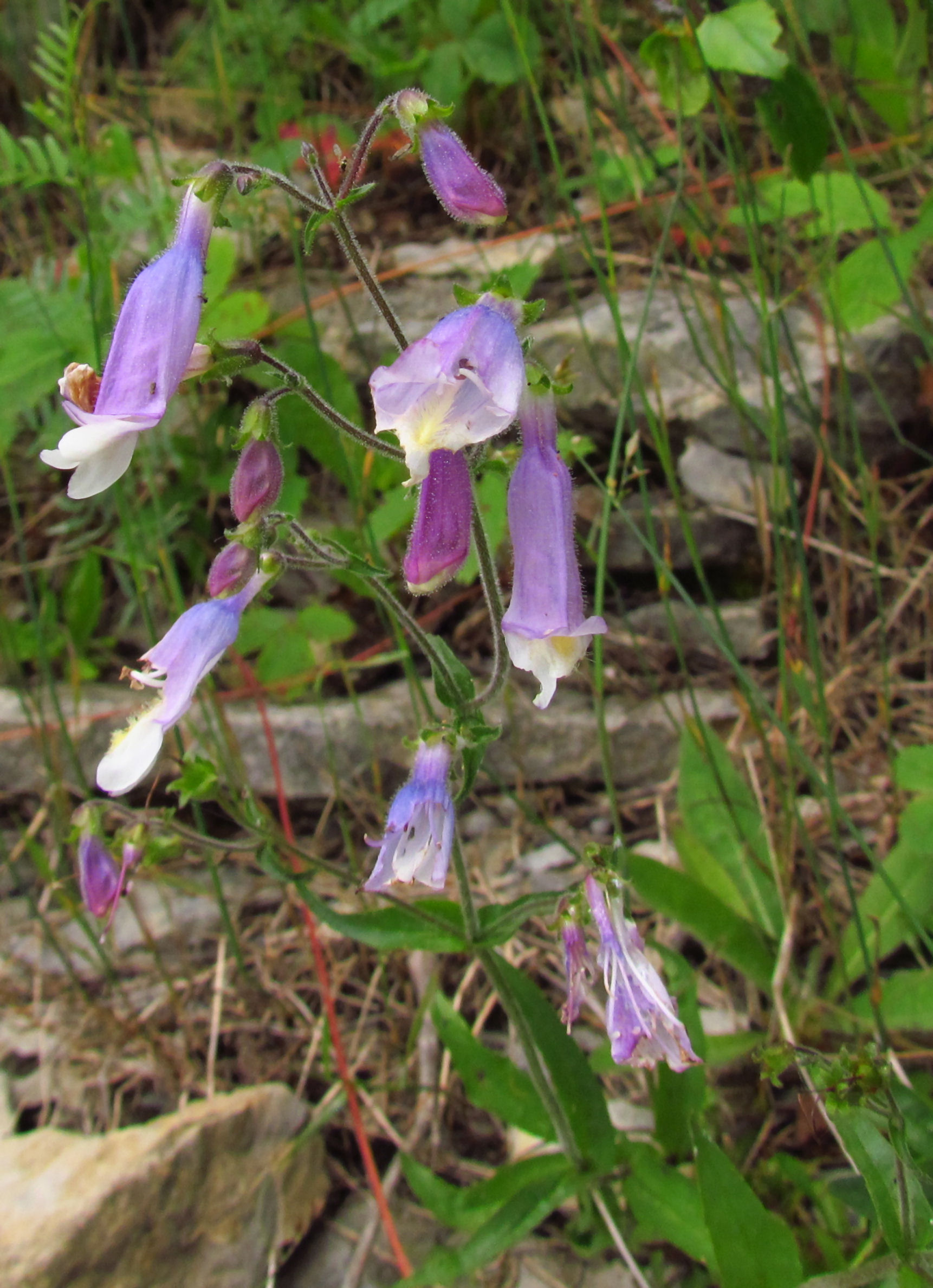
Blue-violet tubular flowers planted along the front edge where the dogs are. Positioned there deliberately: Beardtongue is one of the most urine-tolerant flowering plants we can put at the front of a dog-adjacent bed. The tube shape is sized for bumblebees, which force their way in and collect pollen in the process. Smaller bees simply cannot access these flowers.



Jennifer Anderson, USDA NRCS · Public domain · Wikimedia Commons

The season closer. Deep purple-pink daisy flowers that erupt in September when almost everything else has wound down, giving the bed a second act that rivals spring. Forty plants spread through the mid-section anchor the fall display. Monarchs passing through Maine on the way to Mexico depend on late-season nectar like this. One of the most ecologically important plants in the planting.

Laval University · CC BY-SA 4.0 · Wikimedia Commons

The drought specialist of the goldenrod family. Where other goldenrods need moisture, Gray Goldenrod thrives in poor, dry, sun-baked soil, which is exactly what a parking lot heat island delivers. Arching wands of golden yellow from August into October, then holding feathery seed heads as winter bird food. Thirty-seven plugs in the front zone where conditions are hardest.

Justin Meissen · CC BY-SA 2.0 · Wikimedia Commons
.jpg)
The first real yellow of the season, opening weeks before almost anything else. Flat-topped clusters of small golden flowers on deep green foliage. One of the earliest reliable nectar sources for native bees coming out of winter, and the host plant for Black Swallowtail butterfly caterpillars. Twenty-two plants in the left mid-zone anchor the early spring display.

Cephas · CC BY-SA 4.0 · Wikimedia Commons

The midsummer bridge. Lavender-pink ragged blooms with a distinctive spiky texture that contrasts beautifully against the bolder forms around it. Crush a leaf and you get a strong wild oregano scent. It is in the mint family and the connection is unmistakable. Twenty plugs in the center of the bed. As plugs, these may not bloom in the first year, but the show will be worth the wait in subsequent seasons as they fill in and spread.

Agnieszka Kwiecień, Nova · CC BY-SA 4.0 · Wikimedia Commons

The toughest edge plant in the bed. Native to rocky barrens and alpine ridges, it handles the most extreme conditions here: parking lot compaction, reflected heat, and direct dog traffic at the front corner. Small white flowers in summer give way to brilliant deep red fall color that surprises everyone. A low mat that holds the dry corner and asks nothing in return.

Jean-Pol GRANDMONT · CC BY-SA 3.0 · Wikimedia Commons
.JPG)
The deep indigo anchor of the rear zone. A structural shrub-like perennial that gets more impressive every single year for two decades. Deep blue-violet pea-family flowers in late spring, then inflated seed pods that rattle in autumn wind. Five plants placed in the back left, where their eventual 3 to 4 foot spread will fill the space over time. The longest-lived plant in this bed.

Douglas Goldman · CC BY-SA 4.0 · Wikimedia Commons

A low native shrub with fluffy white flower clusters in early summer. Three plants clustered in the rear right zone, where their deep root systems will anchor that corner against drought. When in bloom it supports over 30 native bee species, making it one of the highest-density pollinator plants per square foot in the entire planting. The white flowers provide the strongest color contrast in the blue-to-gold palette.


USGS Bee Inventory and Monitoring Lab · Public domain · Wikimedia Commons
.jpg)

USGS Bee Inventory and Monitoring Lab · Public domain · Wikimedia Commons
.jpg)

Sandy Rae · CC BY-SA 3.0 · Wikimedia Commons
.jpg)

Kenneth Dwain Harrelson · CC BY-SA 3.0 · Wikimedia Commons


Acroterion · CC BY-SA 4.0 · Wikimedia Commons


HaarFager at en.wikipedia · CC BY-SA 3.0 · Wikimedia Commons


Paul Danese · CC BY-SA 4.0 · Wikimedia Commons

Rhododendrites · CC BY-SA 4.0 · Wikimedia Commons
.jpg)
This planting was designed for continuous color and structure from early spring through the first hard frost and into winter. Each species holds a distinct window in the season.
Every choice was made with Woof Play Eat in mind: parking lot heat, full sun, dog traffic at the edges, and a blue-to-gold palette that reads from the parking lot.
Before lawns, before parking lots, before ornamental shrubs shipped from overseas: these plants were here. They built the soil, fed the insects, and held the food web together. Putting them back, even in a small bed outside a dog park, is not a gesture. It is a genuine act of restoration.
across 10 species
by New Jersey Tea alone
in this bed
| Cultivar / nativar | Straight species (this planting) |
|---|---|
| Bred for human aesthetics only | Shaped by 10,000 years of ecology |
| Supports generalist pollinators only | Supports specialist and generalist bees |
| Less effective as caterpillar host | Host plant for multiple species |
| Genetically narrow, often disease-prone | Genetically diverse and locally resilient |
@woof_play_eat
chris@wildheartnativescapes.com
Wild Heart Nativescapes designs and installs native plant gardens for homes and businesses throughout Maine. Every planting uses straight species from local ecotypes wherever possible, not cultivars bred for human aesthetics, but plants genetically shaped by this specific region over thousands of years. That distinction matters. Local-ecotype plants support specialist pollinators, host native caterpillars, and fit the soil and climate in ways that no nursery hybrid can replicate.
This is restoration work, not just landscaping. Every planting is a small act of ecological repair, returning function to land that has lost it, one garden at a time.
The Woof Play Eat planting is one of our first commercial installs. Designed for full southwest sun, parking lot heat, and dogs at the margins. We are proud of how it came together.